Get decimal hours by measure type

0.5 can mean half an hour, 12 hours or noon. The measure type decides.
Download Excel templateMicrosoft 365
What you'll make
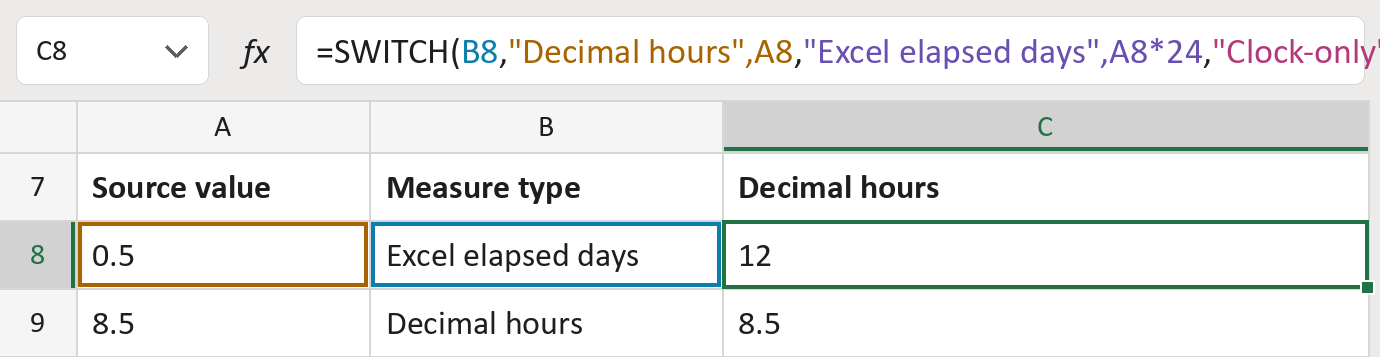
The formula
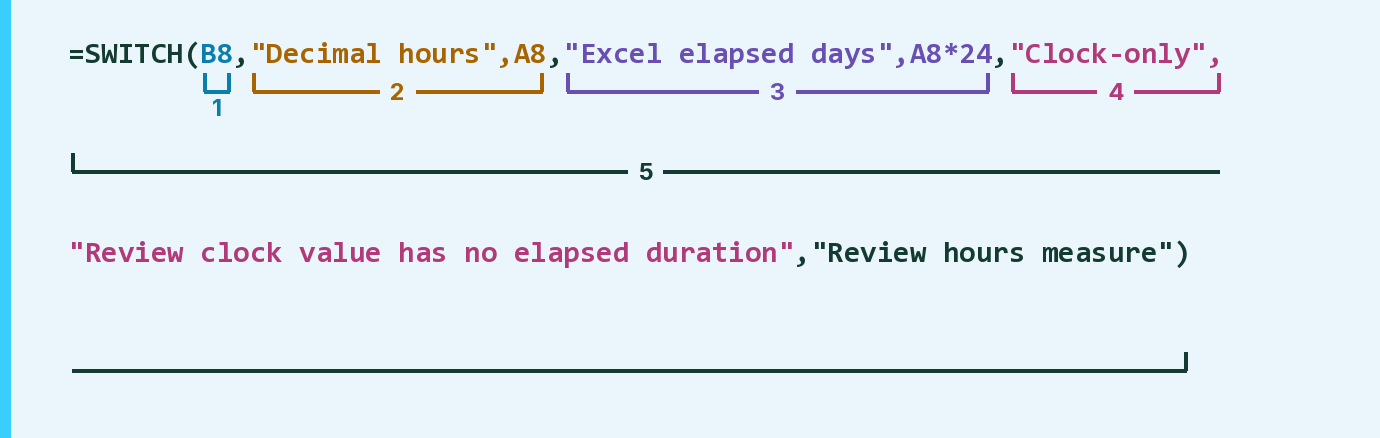
| Number | Part | What it does | Result so far |
|---|---|---|---|
| 1 | B8 | Reads the measure type for this row. | "Excel elapsed days" |
| 2 | "Decimal hours",A8 | Hours already: keeps the value as it is. | Not used for row 8 |
| 3 | "Excel elapsed days",A8*24 | Days: times 24 for hours. | 12 |
| 4 | "Clock-only", … | A clock time: flags it, since it has no length. | Not used for row 8 |
| 5 | SWITCH( … ) | Uses the part that matches the measure type. | 12 |
Read it left to right. Any other type says Review hours measure. Excel counts time in days.
=SWITCH(B8,"Decimal hours",A8,"Excel elapsed days",A8*24,"Clock-only","Review clock value has no elapsed duration","Review hours measure")How to use it
Yellow bar at the top? Click Enable Editing.
- See it work. The Example tab shows 20 made-up examples with the formula already in.
- Use your own values. Paste each value and its measure type into the green columns of the Template tab. The types are Decimal hours, Excel elapsed days or Clock-only. The hours fill in by themselves.
- Move them into your letter. Copy the results. Then use Paste Special and choose Values.
Before you send
Take the measure type from the source system's field list; never guess it from the size of the number.
Microsoft's help: SWITCH function
OTHER ROUTES YOU MIGHT LIKE
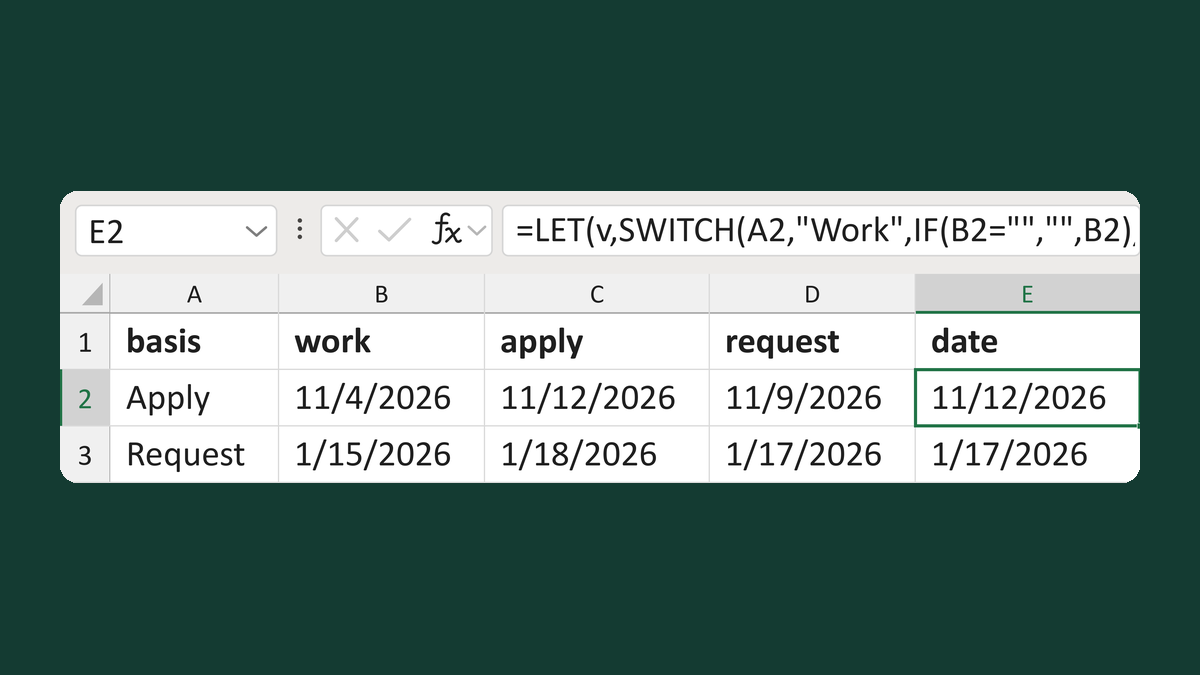
Pick the work, apply or request date
Apply: work 11/4/2026, apply 11/12/2026 → 11/12/2026
Get the template →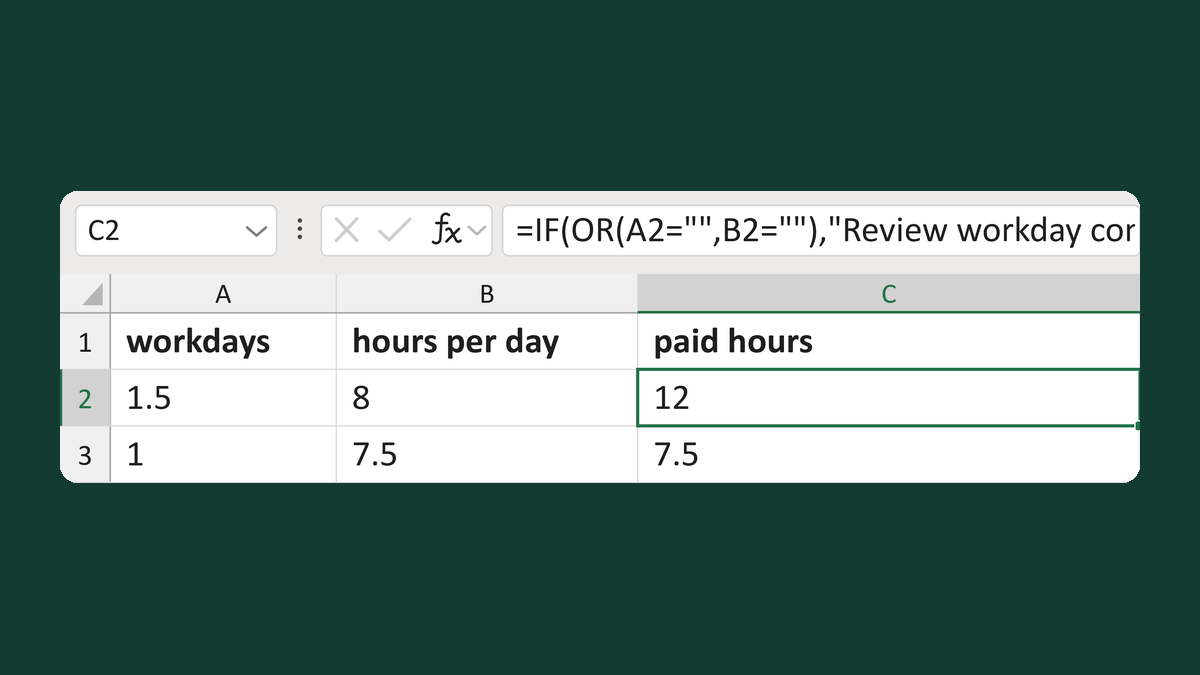
Turn workdays into paid hours
1.5 workdays at 8 paid hours → 12 hours
Get the template →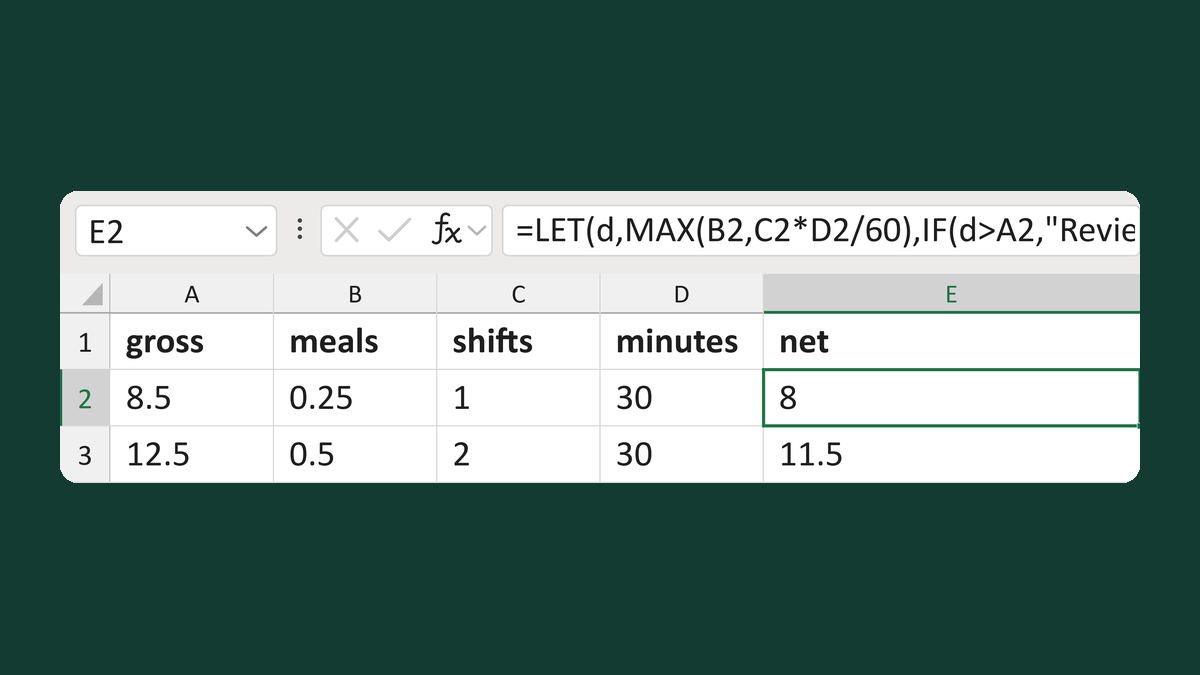
Subtract the larger meal time from hours
8.5 hours, 0.25 meal, 30-minute minimum → 8 hours
Get the template →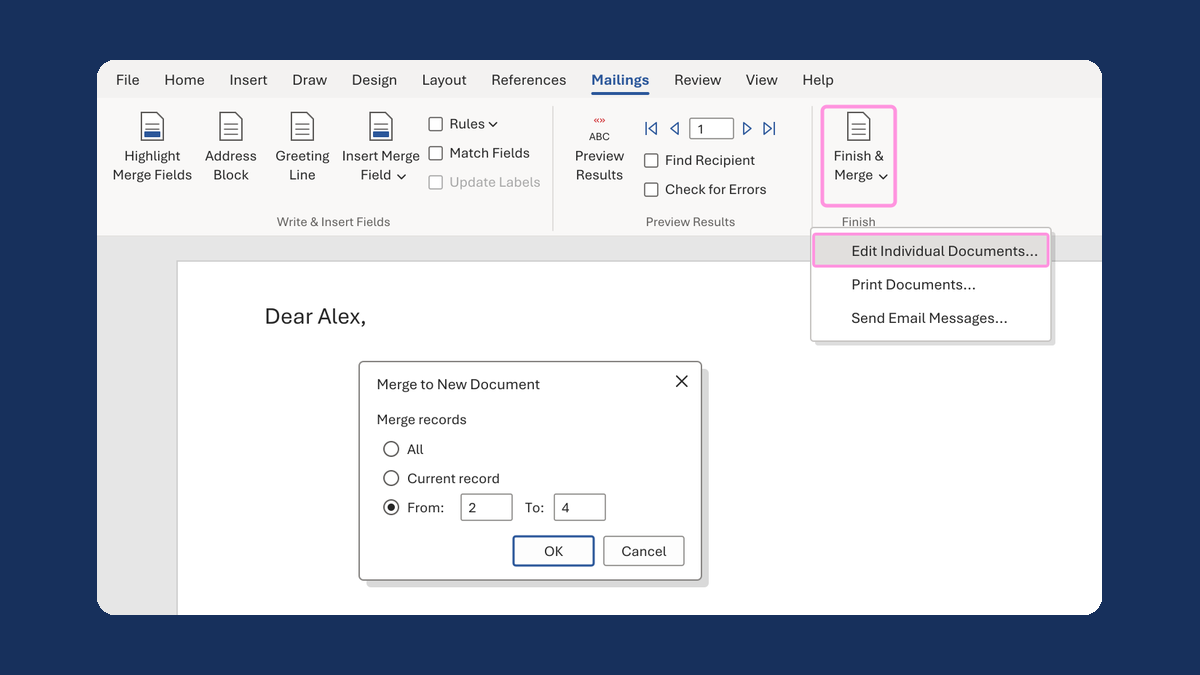
Merge a few test letters before the whole mailing
Whole mailing → records 2 to 4 only
Take this route →