Label a payment adjustment

A payment adjustment can be about an earlier payment. Label it on its own line.
What you'll make
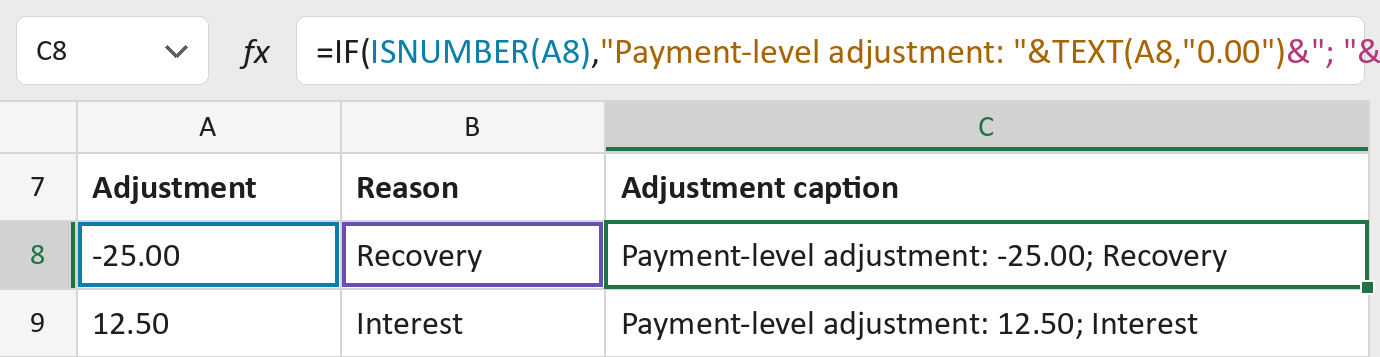
The formula
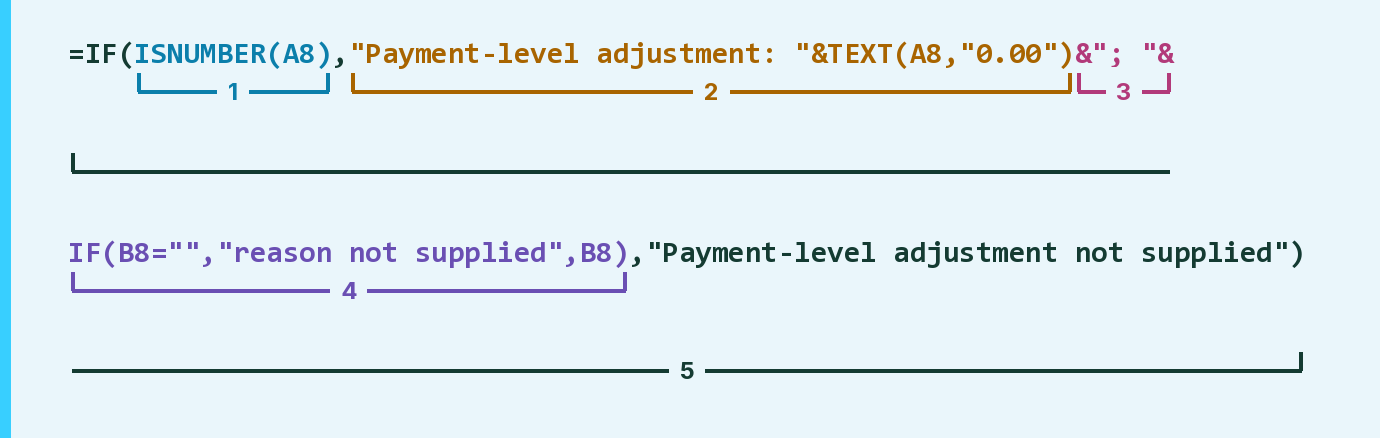
| Number | Part | What it does | Result so far |
|---|---|---|---|
| 1 | ISNUMBER(A8) | Checks that the amount is a real number. | TRUE |
| 2 | "Payment-level adjustment: "&TEXT(A8,"0.00") | Writes the label and the amount with two decimals. | "… adjustment: -25.00" |
| 3 | &"; "& | Adds a semicolon and a space. | "…: -25.00; " |
| 4 | IF(B8="","reason not supplied",B8) | Adds the reason, or reason not supplied. | "…; Recovery" |
| 5 | IF( … ) | Says not supplied when there's no amount, else uses parts 2 to 4. | "…: -25.00; Recovery" |
Read it left to right. The amount is only labeled, never added to anything. All amounts are made-up.
=IF(ISNUMBER(A8),"Payment-level adjustment: "&TEXT(A8,"0.00")&"; "&IF(B8="","reason not supplied",B8),"Payment-level adjustment not supplied")How to use it
Yellow bar at the top? Click Enable Editing.
- See it work. The Example tab shows 20 made-up examples with the formula already in.
- Use your own list. Paste each payment adjustment amount and its reason into the green columns of the Template tab.
- Move them into your letter. Copy the results. Then use Paste Special and choose Values.
Before you send
Keep this off the patient's bill. An adjustment can recover an earlier payment, not a new charge.
Microsoft's help: TEXT function
OTHER ROUTES YOU MIGHT LIKE
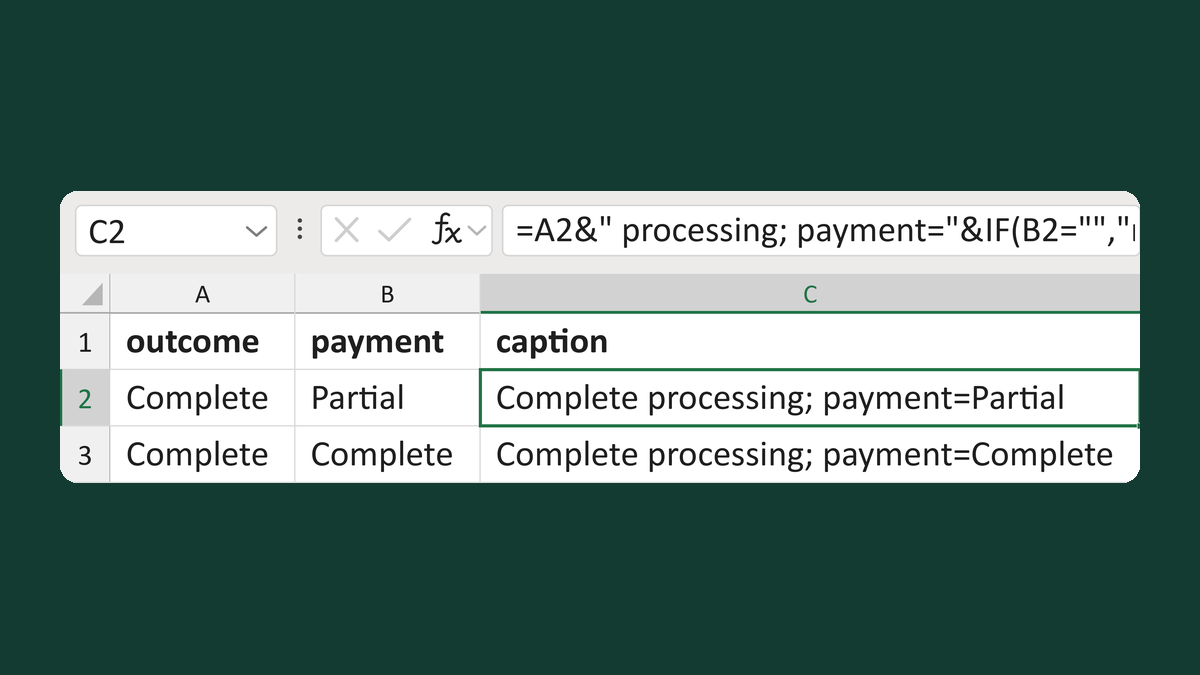
Keep payment type and outcome apart
Complete + Partial → Complete processing; payment=Partial
Get the template →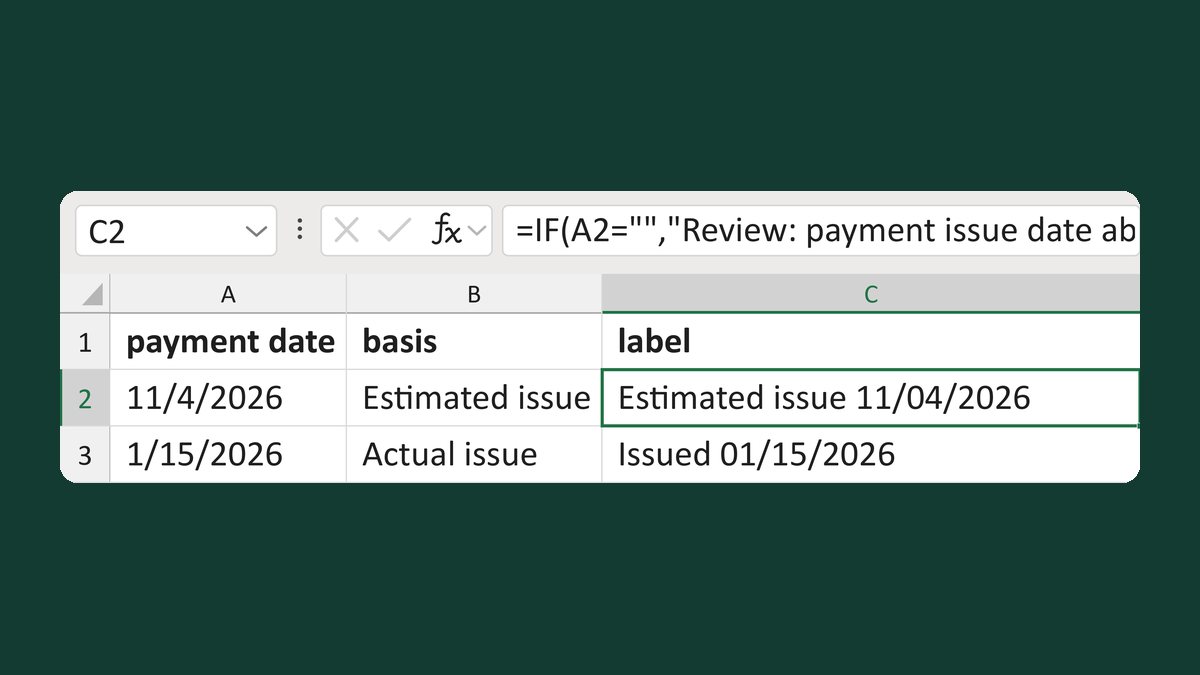
Label estimated or actual issue dates
11/4/2026, Estimated issue → Estimated issue 11/04/2026
Get the template →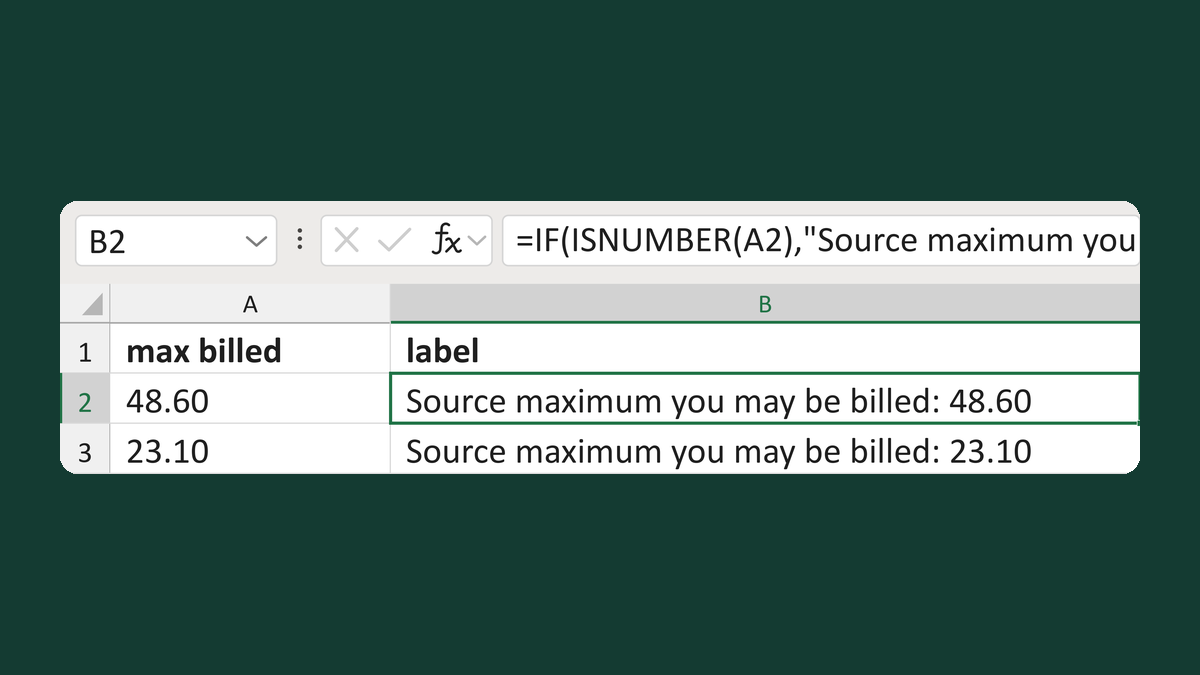
Label the maximum you may be billed
48.60 → Source maximum you may be billed: 48.60
Get the template →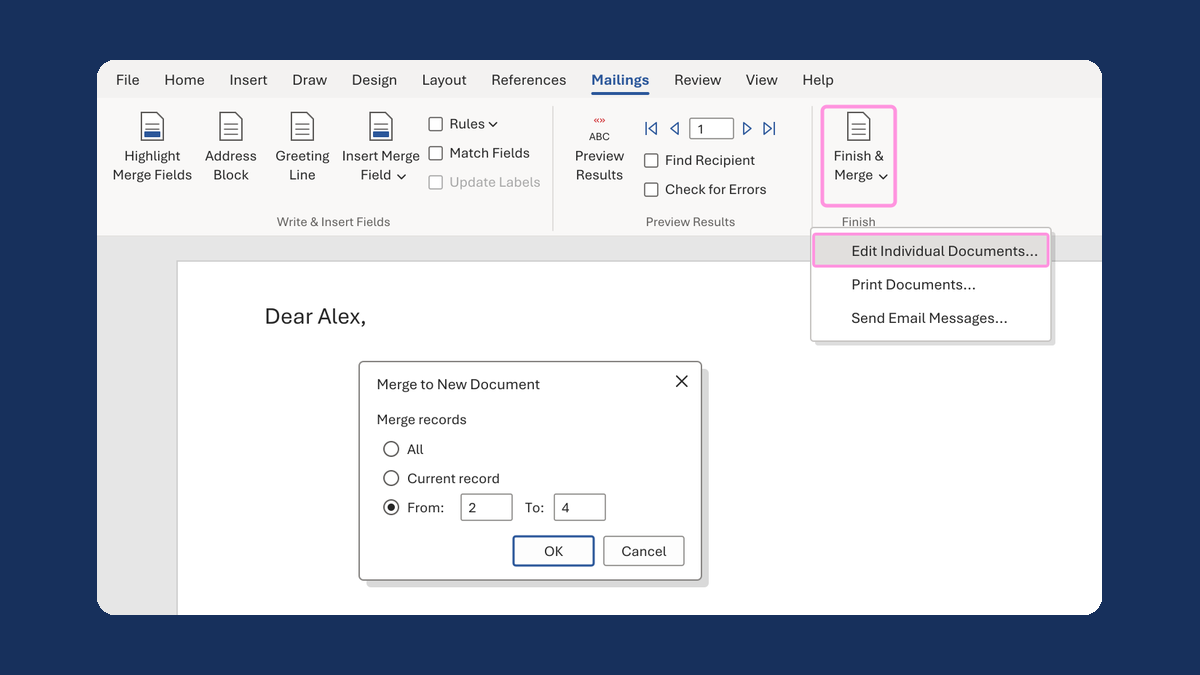
Merge a few test letters before the whole mailing
Whole mailing → records 2 to 4 only
Take this route →